
The Short Answer
Planning your stay?
Stays — check availability and book direct.
Maltese food is a Mediterranean kitchen with Sicilian and North African accents. Start with pastizzi (€0.40), a Gozitan ftira, and a proper fenkata (rabbit stew), then wash it all down with a Kinnie or a Cisk. Eat fish at Marsaxlokk on Sunday, browse the Valletta food market, and cook market produce in your own kitchen at a self-catering villa in Sliema.
Insider Tip
For the cheapest, best pastizzi, skip the cafes and find a hole-in-the-wall pastizzeria where locals queue. Crystal Palace in Rabat (open more or less around the clock) sells them hot for about €0.40 each. Two of those and a tea is a Maltese breakfast for under €2.
Maltese food is one of the best reasons to come to these islands, and one of the most underrated. It is a true Mediterranean kitchen, built on bread, fish, rabbit, tomatoes, olives, capers and ricotta, then shaped over centuries by the cooks who passed through: Sicilians, Arabs and North Africans, and later the British. The result is a cuisine that tastes familiar and surprising at the same time.
This is hearty, honest, peasant-rooted cooking. Slow-braised meat, soups thickened with rice, savoury pastry you eat with your hands, and sweets soaked in honey and treacle. Almost none of it is fussy, and almost all of it rewards you for being curious. Below are 15 traditional dishes and drinks worth seeking out, what each one actually is, where to eat the best version, and roughly what you should pay.
We have left out the gloss you find in some food guides. No “culinary journey”, no inflated prices. Just the food a local would actually point you toward, plus a few honest trade-offs about where to go and where to give a miss.
What is Maltese food, and where does it come from?

Malta sits 80km south of Sicily and 290km north of Tunisia, and the food reflects exactly that position on the map. From Sicily and the wider Italian south came pasta bakes, ricotta, cannoli and a love of tomatoes. From North Africa came spices, dates, semolina and a knack for using every scrap of bread and bean. The British left behind a soft spot for a fried breakfast and a pint, plus the habit of an afternoon tea.
What ties it together is the produce. Sun-ripened tomatoes, sea salt, olive oil, capers that grow wild out of old walls, and fish landed that morning. Because Malta is small and farms are tiny, ingredients are seasonal and local by default. Lampuki only appears in late summer and autumn. Rabbit is a year-round comfort. Fresh sheep and goat cheese is made in small batches you will not find in a supermarket back home.
Want a kitchen to cook the market haul?
Check DatesThe 15 traditional Maltese dishes at a glance
Here is the full list in one place. Use it as a checklist while you are here. Below the table we go into each one in more detail, with the why and the where.
| Dish | What it is | Where to try it |
|---|---|---|
| Pastizzi | Flaky pastry parcels filled with ricotta or mushy peas | Crystal Palace, Rabat; any pastizzeria |
| Ftira | Ring-shaped sourdough bread, often a UNESCO-listed Gozo sandwich | Gozo; Maltese bakeries island-wide |
| Fenkata (rabbit stew) | Communal rabbit feast; the national dish | Mgarr; village restaurants inland |
| Bragioli | Beef olives stuffed with egg, bacon and breadcrumb, braised in wine | Traditional Maltese restaurants |
| Lampuki pie | Autumn fish pie with spinach, capers and olives | Marsaxlokk, Aug to Dec |
| Aljotta | Garlicky lemon fish soup thickened with rice | Seafront fish restaurants |
| Gbejniet | Small fresh sheep cheeselets, plain, peppered or dried | Gozo farms; Maltese platters |
| Hobz biz-zejt | Crusty bread rubbed with tomato, oil, capers and tuna | Cafes, kiosks, beach snack bars |
| Kapunata | Maltese caponata: aubergine, tomato, capers, olives | Side dish in local restaurants |
| Timpana | Baked macaroni in a pastry crust with meat and egg | Bakeries; village feasts |
| Qaghaq tal-ghasel | Treacle-filled honey rings, a Christmas favourite | Confectioners and bakeries |
| Kinnie | Bittersweet local soft drink made with chinotto orange | Everywhere, ice cold |
| Cisk | Malta’s light, easy-drinking lager | Any bar; €2 to €3.50 a pint |
| Imqaret | Deep-fried diamond pastries with date paste | Valletta and Marsaxlokk stalls |
| Kannoli | Fried pastry tubes filled with sweet ricotta | Cafes and bakeries island-wide |
Savoury snacks: pastizzi, ftira and hobz biz-zejt
If you eat one thing in Malta, make it a pastizz. These diamond-shaped parcels of crisp, flaky pastry come with two classic fillings: smooth ricotta (tal-irkotta) or a savoury mushy-pea paste (tal-pizelli). They cost around €0.40 to €0.60 each, they are sold hot all day, and they are the everyday snack that keeps the country running. Crystal Palace in Rabat is the legend, but every town has a pastizzeria worth a try.
The ftira is Malta’s bread, and the Gozitan version is so cherished it earned UNESCO Intangible Cultural Heritage status. The dough is shaped into a ring with a crunchy crust and a dense, chewy crumb. Split it and you have the ultimate Maltese sandwich: tuna, tomato, capers, olives, onion, sometimes potato or boiled egg, all bound with good olive oil. Order one from a village bakery for €3 to €5 and it will keep you going all afternoon.
Hobz biz-zejt is the simplest and one of the best. It is a thick slice of crusty Maltese bread rubbed with ripe tomato and olive oil, then topped with capers, olives and tuna or anchovies. You will see it at kiosks, beach snack bars and cafes, usually for €2 to €4. It is also the easiest Maltese dish to make yourself, which we come back to later.
The national dish: fenkata and rabbit stew
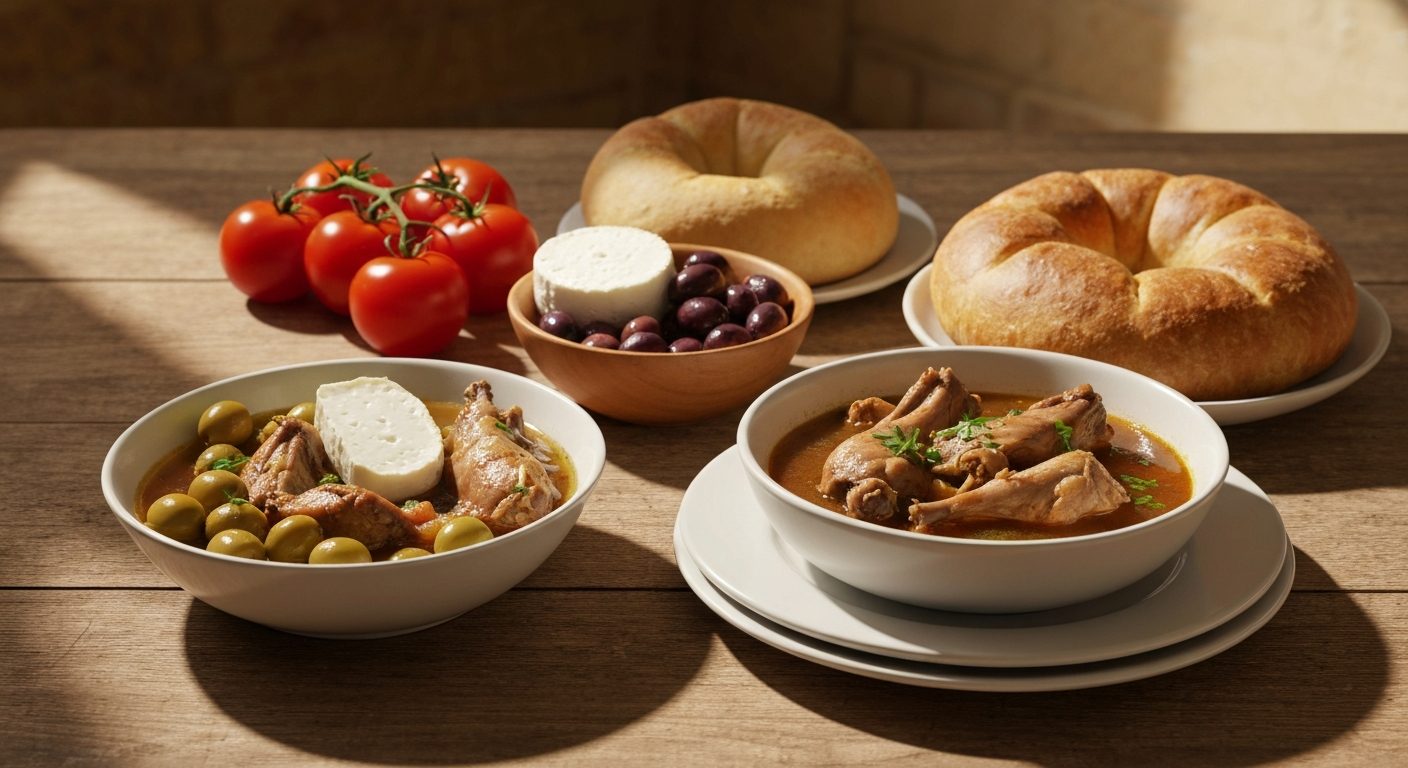
Ask any local what Malta’s national dish is and the answer is rabbit. A fenkata is the full experience: a long, communal rabbit feast usually split across two courses. First, spaghetti or fenkata pasta dressed in the rich rabbit gravy. Then the rabbit itself, either fried in garlic and wine or slow-cooked as stuffat tal-fenek, a deep tomato and red-wine stew. It is the meal Maltese families gather for, and it is best had inland, away from the tourist seafronts.
The village of Mgarr is the spiritual home of the fenkata, and a handful of long-running restaurants there build their menus around it. Expect to pay roughly €18 to €28 for the rabbit, more if you go for the full two-course set. Book ahead at weekends, and go hungry. This is not a quick lunch, it is an afternoon.
Two more meat classics are worth your time. Bragioli, or beef olives, are thin slices of beef wrapped around a filling of minced meat, bacon, egg and breadcrumbs, then braised slowly in a tomato and wine sauce until they fall apart. And timpana is the great Maltese pasta bake: macaroni in a meaty, egg-bound sauce, sealed inside a pastry crust and baked until golden. You will find a slice in many bakeries for a couple of euros.
From the sea: lampuki pie, aljotta and Marsaxlokk fish
Lampuki pie is a true taste of the Maltese autumn. Lampuki (mahi-mahi, or dolphin fish) runs in local waters from roughly August to December, and when it does, it goes into a savoury pie with spinach, cauliflower, olives, capers and tomato under a pastry lid. If you visit in those months, this is the dish to chase. Outside the season you simply will not find the real thing, and that honesty is part of the charm.
Aljotta is Malta’s fish soup: a lemony, garlicky broth made from small fish and fish stock, sharpened with tomato and mint and thickened with rice. It is light, restorative and especially popular during Lent. A good bowl runs €8 to €12 in a seafront restaurant and makes an ideal starter before something heavier.
For the freshest fish of all, go to Marsaxlokk. This working fishing village in the south fills with colourful luzzu boats, and on Sundays it hosts a famous market where the morning’s catch is sold along the quay. The waterfront restaurants serve whatever came in: sea bream, sea bass, octopus, prawns, often simply grilled with lemon and oil. It is a 30 to 40 minute bus ride from Sliema, and worth every minute.
“A very well appointed property with a bakery just up the road one way and a corner shop the other, plus an excellent ice cream shop down by the seaside. Susan and Sunil were both very helpful. We did not have a car but walked or used local taxis, and it was easy to get around.”
Cheese, vegetables and the Maltese platter
No food tour of Malta is complete without gbejniet, small round cheeselets made from sheep’s or goat’s milk, mostly in Gozo. You will meet three versions: fresh and soft, dusted with cracked black pepper, or dried until firm and tangy. They turn up in salads, baked in pasta, or front and centre on a platt malti, the sharing platter of Maltese bits and pieces.
That platter is the easiest way to taste a lot at once. A typical platt malti brings together:
- Gbejniet, the fresh or peppered sheep cheeselets
- Bigilla, a thick broad-bean and garlic dip, more robust than hummus
- Sun-dried tomatoes and wild capers in oil
- Galletti, crisp water crackers, plus crusty Maltese bread
- Maltese sausage (zalzett), cured with garlic, coriander seed and parsley
- Bigilla’s cousin: olives, pickled onions and a few slices of bragioli when you are lucky
On the vegetable side, look for kapunata, the Maltese take on caponata: aubergine, tomato, peppers, capers and olives stewed together into a sweet-sharp side that goes with almost anything. It is excellent cold the next day, which makes it a self-catering favourite.
Sweets and drinks: imqaret, kannoli, Kinnie and Cisk
Maltese sweets lean on dates, honey, treacle and ricotta. Imqaret are deep-fried diamond-shaped pastries stuffed with a spiced date paste, crisp outside and sticky inside. You will smell them before you see them at stalls in Valletta and by the Marsaxlokk waterfront, usually €1 to €2 each, best eaten hot in your hand.
Kannoli are the local cousin of the Sicilian cannolo: crunchy fried pastry tubes filled to order with sweet, fresh ricotta, sometimes finished with candied peel or chocolate. And at Christmas, look for qaghaq tal-ghasel, large pastry rings filled with a dark, spiced treacle mixture. They are made year-round in some bakeries, but they belong to the festive season.
Two drinks are practically national symbols. Kinnie is a bittersweet soft drink made from bitter chinotto oranges and aromatic herbs, amber in colour, an acquired taste that quickly becomes a habit. Cisk (say “chisk”) is Malta’s light lager, easy-drinking and refreshing in the heat, usually €2 to €3.50 a pint. Order both ice cold and you have the perfect end to a Maltese meal. Wine lovers should also try the local Gellewza and Girgentina grapes, grown only here.
Where to eat: Marsaxlokk, Valletta and Sliema

Each of Malta’s food towns has a job to do. Use them in the right order and you will eat well all week:
- Marsaxlokk for fish, ideally on a Sunday when the market is in full swing and the catch is at its freshest.
- Valletta for variety: the covered Is-Suq tal-Belt food market, classic restaurants like Nenu the Artisan Baker for ftira and timpana, and street imqaret. It pairs perfectly with a day exploring the things to do in Valletta.
- Rabat for round-the-clock pastizzi at Crystal Palace, an easy add-on to a Mdina visit.
- Sliema for everyday eating: cafes, kiosks, gelato along the front, and the convenience of being able to shop and cook at home.
One honest note on price. Eating out adds up, especially at the tourist seafronts, and that is part of how expensive Malta can feel on a longer trip. If you want to understand the wider budget picture, our guide on how expensive Malta is breaks it down. The simplest way to keep costs sensible is to mix restaurant meals with a few you cook yourself.
Cook Malta at home in Sliema
Aster House is a luxury Art-Deco villa in central Sliema, sleeping up to 9 and just 150m from the sea. With a fully equipped kitchen and a BBQ terrace, you can shop the market and cook your own fish supper. Book direct, with no booking fees.
Check Dates & Book DirectCook it yourself: self-catering with Maltese market produce
Some of the best Maltese food never makes it to a restaurant table. It is what locals cook at home from the morning market: a bowl of kapunata, a plate of grilled fish, hobz biz-zejt thrown together for lunch. Staying somewhere with a real kitchen lets you join in. The Marsaxlokk Sunday market, the Valletta covered market and the small greengrocers in Sliema all sell tomatoes, capers, gbejniet, fresh fish and Maltese bread for a fraction of restaurant prices.
This is exactly where self-catering earns its keep. At a self-catering villa in Sliema you have the whole place to yourselves, a proper kitchen, and a BBQ and dining terrace for long, lazy meals. Grill the catch you bought that morning, open a bottle of local wine, and crack open a Cisk. Aster House sits 150m from the sea in central Sliema, so the market, the fish and the ferry to Valletta are all within easy reach.
The honest trade-off is that you will not cook every night, and you should not try to. The joy of Maltese food is balance: a fenkata out in Mgarr, pastizzi on the way to the bus, a slow home-cooked supper on the terrace. Do all three and you will leave understanding why locals are so proud of their kitchen.
Your base for a Maltese food trip
Aster House is a luxury Art-Deco villa in Sliema, sleeping 9 and 150m from the sea, with a kitchen and terrace made for cooking and sharing. Book direct and pay no booking fees.
Check Dates & Book Direct