
The Short Answer
Planning your stay?
Stays — check availability and book direct.
Marsaxlokk is Malta’s traditional fishing village in the south, lined with brightly painted luzzu boats and best known for its Sunday market and fresh seafood restaurants. Come on a Sunday morning before 9am for the famous fish market, or pick a weekday if you want the harbour quiet and the restaurant tables easy to get. From Sliema it is roughly 45 minutes by bus or 30 to 40 by car. Make it a relaxed half-day from a central base like a villa in Sliema, then be back at the seafront for the evening.
Insider Tip
On a Sunday, get to Marsaxlokk before 9am. That is when the fishermen still have the morning catch laid out, the light on the luzzu boats is at its best, and the big tour coaches have not arrived yet. By 10:30 the promenade is shoulder to shoulder and the parking is gone. If you are driving, head for the free car park near the football ground rather than circling the waterfront.
If you have been scrolling photos of Malta, you have already seen Marsaxlokk even if you did not know the name. It is the harbour full of small wooden boats painted red, blue, yellow and green, each with a pair of eyes on the bow. This is Malta’s working fishing village in the south of the island, and it is one of the most photographed spots in the country for good reason.
The name is pronounced “mar-sa-shlok”, and it comes from the Maltese for the harbour of the southeast wind. This guide covers what to actually do in the village, when the market runs and how it differs Sunday versus weekday, where to eat the freshest fish, the swimming spot at St Peter’s Pool nearby, and exactly how to get there from Sliema. We will also be honest about the trade-off between the busy Sunday buzz and the calm of a quiet weekday.
We run Aster House, a luxury villa in central Sliema, and Marsaxlokk is one of the first day trips we point guests toward. So this is the local version, not a list copied off a tour brochure.
What to do in Marsaxlokk: the village at a glance
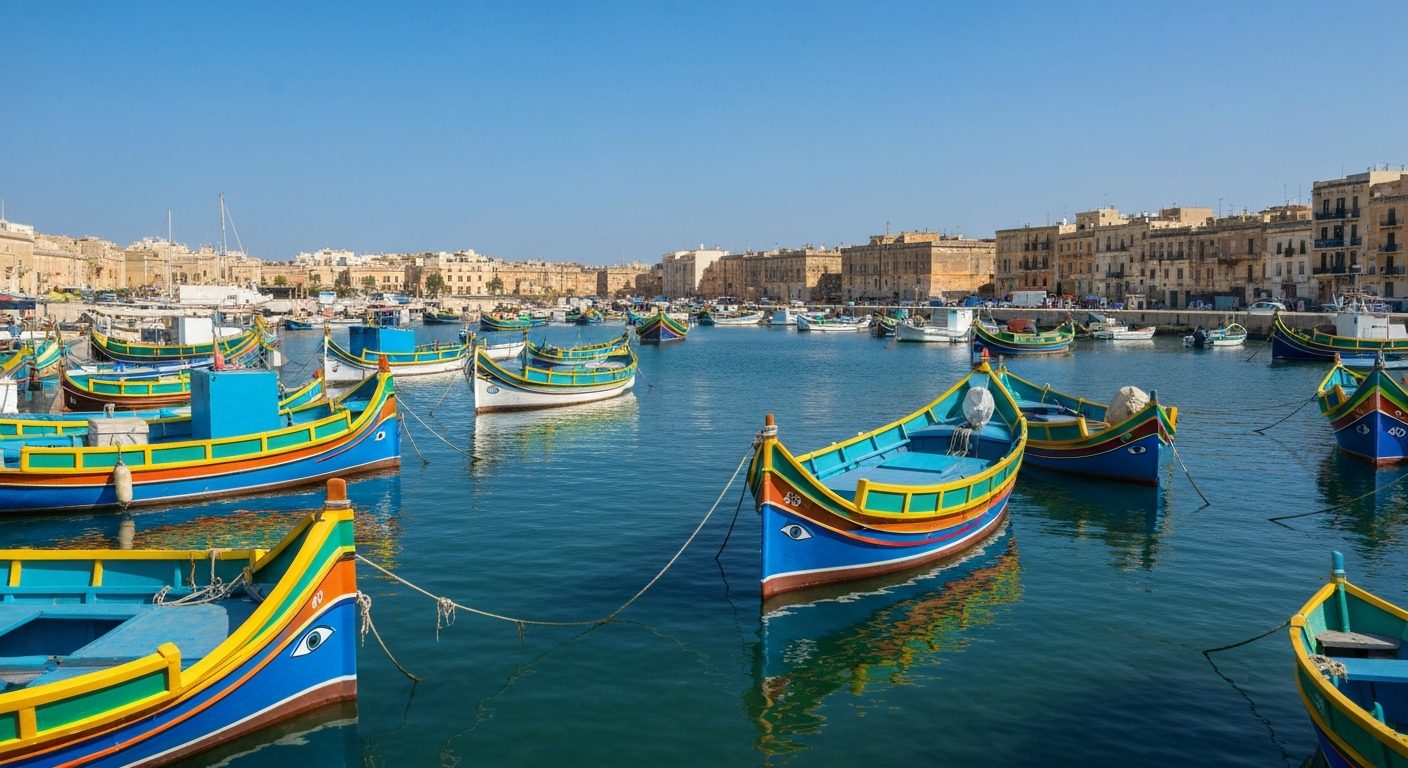
Marsaxlokk is small, and that is part of the charm. The whole place fits along one curving waterfront promenade, so there is no real planning needed. You wander, you look at the boats, you browse the stalls, you sit down for lunch, and you leave. Most people give it two to three hours, which is plenty unless you are pairing it with a swim.
The headline sight is the harbour itself, packed with luzzu boats. These are the traditional Maltese fishing vessels, low and double-ended, painted in bold primary colours. Each one carries a painted eye on the prow, the eye of Osiris or Horus, a protective symbol that fishermen have used since Phoenician times to watch over them at sea. They are still working boats, not museum pieces, which is what makes the harbour feel alive rather than staged.
Set back from the water is the parish church, dedicated to Our Lady of Pompeii. It was built at the end of the 1800s and has the typical Maltese interior of gold, white and red. If your visit lands on the first Sunday in August, you will catch the village feast, with the church lit up, band marches and fireworks in the evening. It is a genuine local celebration rather than a tourist event.
Want a central base for easy day trips?
Check Aster House DatesThe Marsaxlokk market: Sunday versus weekday
The Marsaxlokk market is the reason most people come, but there is a common mix-up worth clearing up first. There is a market on the promenade every day of the week, and then there is the bigger Sunday version. They are not the same thing, and which one you get depends entirely on the day you turn up.
From Monday to Saturday, the stalls run roughly from early morning until early afternoon, and the focus is general goods: clothes, souvenirs, ceramics, sunglasses, CDs, local honey and nougat, paintings and the usual seaside bits. It is pleasant and uncrowded, but it is not the famous fish market.
On Sunday the village transforms. The fishermen bring in the morning catch and the seafront fills with fish stalls alongside the general traders. This is when you see swordfish, tuna, prawns, sea bream and, in season, lampuki laid out on ice straight off the boats. The Sunday market runs from around 7am, with stalls setting up from 6:30, and the fish section starts thinning out by lunchtime, so it is very much a morning event.
| Detail | Weekday market (Mon to Sat) | Sunday market |
|---|---|---|
| Rough hours | Around 8am to early afternoon | From 7am, fish section quiet by 12:30 to 1pm |
| Main focus | Clothes, souvenirs, ornaments, local food | Fresh fish plus the full souvenir market |
| Crowds | Light and relaxed | Very busy, tour coaches arrive mid-morning |
| Parking | Usually easy | Difficult after about 9:30am |
| Best for | Quiet wander and an easy lunch table | The full spectacle and fresh fish |
So the honest answer on timing: if the fish market and the bustle are what you came for, it has to be Sunday morning, and early. If you would rather have the harbour calm, the boats reflecting in still water and a restaurant table without a wait, pick any weekday. Both versions have the luzzu boats and the views, which are the part that ends up on your camera roll regardless.
What to eat in Marsaxlokk: fresh fish and Maltese plates

This is the best place in Malta to eat fish, full stop. The catch comes off boats moored a few metres from your table, so freshness is not a marketing line here, it is just how it works. The promenade is lined with seafood restaurants, and most will walk you to a display of the day’s fish and let you pick what you want by weight.
A few dishes worth knowing before you sit down:
- Lampuki: the local dolphin fish, caught in abundance in spring and autumn. Grilled simply or baked into a traditional lampuki pie, it is the dish to order if it is in season. Expect somewhere around €10 to €18 for a plate depending on the spot.
- Aljotta: a Maltese fish soup made with garlic, tomato, rice and herbs. A good, lighter starter if you do not want a full fish main.
- Grilled swordfish or tuna: both land here regularly and both grill beautifully. Priced by weight, so check before you commit if you are watching the bill.
- Fresh prawns and sea bream: staples of the Sunday catch and a safe, reliable order at any of the harbour restaurants.
- Bragioli and rabbit: if someone in your group is not a fish person, most kitchens also do Maltese meat dishes, so nobody goes hungry.
For restaurants, Tartarun is the name most often mentioned, a long-standing seafood spot that has earned a place in the Michelin guide. Ir-Rizzu is a reliable family-run choice with an open kitchen, and Ta’ Victor and The Deck are popular for waterfront seating. On a Sunday, book ahead or arrive before 12:30, because the good harbour tables go fast once the market crowd gets hungry.
If you want to read more about Maltese dishes before you travel, or you are planning the wider trip, our Malta itinerary guide slots Marsaxlokk into a sensible route around the island.
St Peter’s Pool: the swimming spot near Marsaxlokk
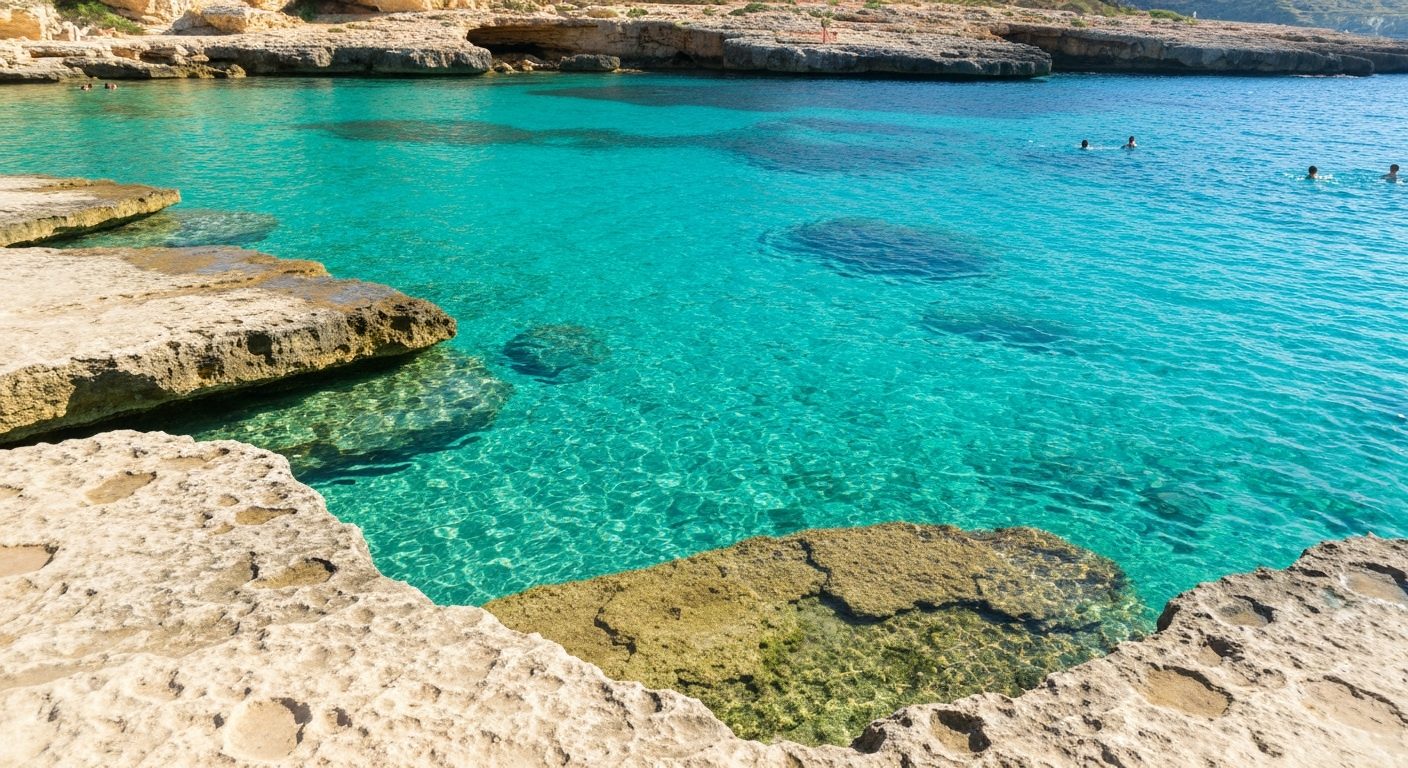
A short way past the village, out along the Delimara headland, is St Peter’s Pool. It is a natural swimming spot, a smooth flat shelf of pale rock cut by a deep, clear inlet of sea. There is no sand and no real facilities, but the water is some of the clearest you will find in Malta, which is why it is a favourite with locals as well as visitors.
From Marsaxlokk it is about a 10 to 15 minute drive, following the road toward the Delimara power station, then parking at the cliff top and walking down. In summer you can also take a short water taxi from the village harbour straight to the bay, which is the easiest option if you are not driving. The smooth rock platforms are good for sunbathing, and the deep water makes for clean entry and decent snorkelling.
A word of honesty and caution. Because there are no lifeguards, no shade and no kiosk, you need to bring your own water, sun cover and shoes that cope with rock. The bay can get rough when the wind blows hard from the south or east, and on those days the swell makes the entry points slippery and the water choppy. You will see people cliff jumping here, but the depth varies and it is genuinely risky, so it is not something we would push anyone toward. On a calm day, though, it is one of the nicest swims on this side of the island.
“A beautiful house with incredible attention to detail. We felt very looked after and loved the thoughtful touches, like the board games and the local recommendations. The rooms are super comfortable and the bathrooms and kitchen very well equipped. A fabulous base for exploring Malta.”
How to get to Marsaxlokk from Sliema
Marsaxlokk sits in the southeast corner of Malta, roughly 13 kilometres from Sliema. There is no single direct bus from Sliema, so the realistic options are a connecting bus journey, a car, or a taxi.
- By bus: the simplest route is to get into Valletta first, then take bus 81 or 85 to Marsaxlokk. From Valletta the 81 runs roughly every 30 minutes and the 85 about hourly, and the ride is around 35 to 45 minutes. Counting the short hop from Sliema into Valletta, allow around 45 minutes to an hour door to door. A single fare on Tallinja buses is about €2 in summer, or €0.75 in winter.
- By car: driving from Sliema takes about 30 to 40 minutes depending on traffic. Aim for the free car park near the football ground rather than the waterfront, especially on a Sunday when spaces vanish early.
- By taxi or ride app: a taxi runs somewhere around €20 to €30 one way. Handy if you are a group or short on time, and it removes the bus connection at Valletta.
- From the airport: if you are arriving and want to go straight there, bus 119 runs direct from Malta Airport in around 40 minutes, and the village is only about 10 minutes from Luqa by car.
Because it is a half-day trip rather than a full one, many guests pair Marsaxlokk with another stop. It works well alongside a morning of things to do in Valletta, since you change buses there anyway, or with a swim at St Peter’s Pool if the weather is good.
Best time to go and who Marsaxlokk suits
The best time to visit, broadly, is spring or autumn, roughly April to June and September to November. The weather is warm without the peak summer heat, the village is busy but not overwhelmed, and lampuki season in autumn means the freshest local fish on the menus. July and August still work, but you will be sharing the promenade with a lot of people and the midday sun on the open waterfront is fierce.
For time of day and week, the calculation is simple. Sunday morning gives you the full market spectacle and the fish, at the cost of crowds and parking. Any weekday gives you a calm, photogenic harbour and an easy lunch, at the cost of the buzz. There is no wrong choice, just different moods.
Who does it suit? Almost everyone, which is rare. Photographers love the boats, foodies come for the fish, families enjoy the easy flat promenade and the swim afterward, and anyone who wants to see a side of Malta that still works for a living will feel it here. It is less suited to people chasing nightlife or a sandy beach day, both of which are better found elsewhere on the island.
Is Marsaxlokk worth visiting? Our honest take
Yes, and it is one of the few “famous” spots in Malta that we think genuinely lives up to the photos. The luzzu boats are real working vessels, the fish at lunch came off a boat that morning, and the village has kept its character despite the crowds. It is an easy, rewarding half-day that costs very little beyond your lunch.
The honest caveat is the Sunday crush. If your only free day is a Sunday and you cannot face an early start, you may find the market more of a scrum than a charming local scene by late morning. The fix is simple: go early, or go on a weekday and accept that you are trading the fish stalls for peace and quiet. Either way, build it into your wider plans rather than treating it as a destination on its own. From a central base it slots neatly between Valletta, the southern temples and a swim, and you are back at the Sliema seafront in well under an hour.
Base yourself in the middle of it all
Aster House is a luxury Art-Deco villa in central Sliema that sleeps up to 9 and sits just 150m from the sea, with Marsaxlokk, Valletta and the south all an easy trip away. Book direct with no booking fees.
Check Dates & Book Direct